


I once told a room full of my clients that voice notes were one of the most underrated outreach tools out there.
And then I immediately forgot to use them myself.
A while later, my client Erica brought it up in one of our Execution Rooms… and I wrote it down like I was hearing it for the first time.
So here’s the thing I keep re-learning:
Your typed follow-up isn’t getting ignored because people don’t care about you.
It’s getting ignored because typed messages carry zero tone. “Hey, just checking in!” reads exactly the same whether it came from you or a bot.
If you’ve been wondering how to follow up without being pushy (or without being ignored), this is the fix I keep coming back to. Here’s why it works, the two-part script, and the steps.
The short answer
Instead of typing another “just checking in”, record a voice note of 30 to 60 seconds. Say why you thought of them, then ask about them, or ask for nothing at all. People hear your voice and your energy, and it’s much harder to ignore than text.
Why a voice note works
A 30-second voice note is different.
They hear your actual voice. Your energy. The fact that you thought of them while you were doing something else. You can’t fake that with text… and you can’t ignore it the way you ignore text.
And if your brain just said “but I don’t have anyone to send one to”… hang on. Because this isn’t just for past clients.
The voice note I sent to a VP at LinkedIn
I once sent a voice note to the VP of Marketing for Small Business at LinkedIn.
Not a mutual connection. Not a warm lead. A woman with a job title so far above my reach-out pay grade that I almost didn’t send it.
I wasn’t pitching anything. I just thanked her for something that had helped my business, in my own voice, in under a minute.
Here’s what happened:
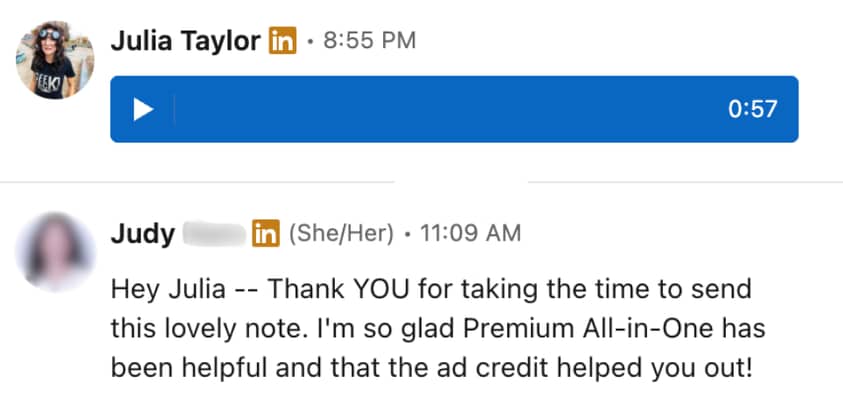
She listened to all 57 seconds. And she took the time to reply.
Because when someone talks to you instead of typing at you, you respond.
How to send a follow-up voice note, step by step
Step 1: Pick one person
Past client. Warm lead who’s gone quiet. Someone whose podcast episode helped you. Someone whose free resource you actually used. Warm or cold, doesn’t matter.
Pick one. Not a list of twenty for today, just one.
Step 2: Find your reason
“Just checking in” isn’t a reason. A good reason is about them, and it’s believable. On my coaching calls I use five:
- Something changed in the market that makes what you do newly relevant to them.
- A recent client result that’s relevant to where they are.
- Something new you learned that you think they’d want to know.
- A mistake or lesson learned, yours or someone else’s.
- Something happening in their world: a launch, an award, a podcast appearance, a new hire. This is the one I use most, and it usually takes a few minutes of looking at their LinkedIn.
Your motive for reaching out can be revenue. We’re running businesses. But the message has to be relevant to them.
Step 3: Use the two-part script
The structure is two parts:
- The reason you thought of them: “Hey, I just saw your post about the launch and thought of you.”
- A question about them… or better yet, no ask at all. A thank-you with zero ask might be the most disarming message a person can receive.
Step 4: Record it (under a minute)
Aim for 30 seconds. Under 60 is fine; mine to the LinkedIn VP was 57.
- Say their name at the start.
- Talk the way you’d talk if you bumped into them, not the way you’d write an email.
- Don’t read a script word for word. Jot your two parts down, then talk.
- One take is fine. A little “um” is proof it’s you and not a bot.
Step 5: Send it where you already talk
Send it on whichever app you already use with that person. On LinkedIn, you can record a voice message in the mobile app. WhatsApp and Instagram DMs work too, and for a past client, a text might be the most natural of all.
Step 6: If they don’t reply
Don’t resend the same message to bump it to the top. Give it about a week, then follow up with a new reason (go back to Step 2). If you still hear nothing, try again in a few weeks, then a month, spacing each touch further apart. Between touches, keep showing up in lighter ways: reply to their newsletter, comment on their posts.
That timing is a starting point, not a rule. Adjust it to the person and the relationship.
Step 7: Put it in your routine
Now here’s the embarrassing part.
It worked. It cost me nothing. It took less than a minute.
And I didn’t do it again for months.
Not because it failed… because it never made it into my Revenue Rhythm, so it disappeared under all the “productive” work. (If that sounds familiar, Busy but Not Making Money? Revenue Work vs. Maintenance Work explains why.)
It’s back in my rhythm now. Pick a day and a number you can keep, like one voice note every Tuesday, and put it where you’ll see it.
Send one today
So today, just send one.
Past client. Someone whose podcast episode helped you. Someone whose free resource you actually used. Warm or cold, doesn’t matter.
Send it before you close this page.
P.S. Someone popped into your head while you were reading this. That wasn’t random. Start there.
This is Move 3 of six in Marketing for Introverts: 6 Visibility Moves That Don’t Require Performing. It’s the same principle as the no-ask compliment, in a different outfit: talk to people instead of at them.
Want the voice note script as a fill-in-the-blank template, plus the other five moves? Grab my free Visibility Pack: six visibility moves you can do from your inbox, each with the exact words to send.
Get the free Visibility Pack →
Frequently asked questions
How do you follow up without being pushy?
Give a real reason that’s about them, not a “just checking in”. Keep it short, ask about them or ask for nothing, and space your follow-ups out. A voice note helps because your tone comes through in a way text can’t.
Is it weird to send a voice message on LinkedIn?
It’s unusual, which is why it works. Keep it under a minute, say why you thought of them, and don’t pitch. Most people are surprised in a good way.
How long should a follow-up voice note be?
Aim for 30 seconds and stay under a minute. Two parts: why you thought of them, and a question about them (or no ask at all).
What should I say in a follow-up after no response?
Don’t repeat the first message. Give a new reason: something in their world, a recent client result, or something you learned that’s relevant to them. Then leave it there.