


A friend said this to me recently, after reading some of my content:
“You do such a great job of showing up that I never would have guessed you’re an introvert like me.”
I am absolutely that woman. I would rather fix a workflow than do outreach. I live on 75 acres in the middle of nowhere. I’m the specific kind of tech-savvy woman who gets excited about a ClickUp board but breaks out in a sweat at the phrase “just go work the room.”
I’ve won awards, had breakfast with Richard Branson, stood on a stage with a supermodel, and interviewed the founder of Build-A-Bear. My coach jokes that I’ve done everything in my business (marketing-wise) kicking and screaming. She’s not wrong.
But I figured out how to do it MY way. Not the extrovert’s way. Not the “just be more confident!” way.
Because when an extrovert tells an introvert to “just be more confident online”… it’s a little like telling someone to just be taller.
Inspiring.
Not actionable.
So this is the actionable version. Below are six marketing moves for introverts that I use in my own business and teach my clients (the 6th one will be a game-changer if you don’t like social media). None of them involve yapping on camera, working a room or posting every day.
The short answer
Marketing for introverts works best when it’s one-to-one, specific and repeated. Instead of broadcasting to everyone, you show up in a few people’s worlds, over and over, being useful and asking for nothing. I call it introverted visibility.
What “introverted visibility” means
This is visibility for people who would rather do almost anything than “put themselves out there”.
You’re not performing.
You’re not posting.
You’re just showing up in someone’s world, repeatedly, being useful and asking for nothing.
Why it works (a view from the other side of the inbox)
I write a newsletter every week. It goes out on a Tuesday, and then I go about my day, and mostly what I get back is data. Opens. Clicks. A dashboard that tells me a percentage of people were there.
What I almost never get is a person.
And when I do (when someone hits reply and says this specific bit, this is the thing that landed) I remember them. Not for a day. I remember their name. I go look them up. And if that person ever needs something from me, or I ever need something from them, they’re already in my head as a real human being rather than a row in a spreadsheet.
That’s not a nice sentiment.
That’s a strategy, and almost nobody uses it.
People who put stuff out into the world get metrics… downloads, plays, follower counts. What they almost never get is a real person saying this specific thing changed how I think about my business.
People remember who made them feel seen. Every move below is built on that one idea.
Move 1: Reply to your dream clients’ newsletters
Who this works for: this only works if your ideal client (or someone well connected who could refer you) is putting content out into the world. A newsletter especially, but social posts count too. If the people you want to work with are completely invisible online, this isn’t your move. Skip to Move 3 instead.
Here it is, in three levels of geekery.
Geek Level 1: Get on their list. Reply to their emails.
Make a list of people you’d LOVE to work with. Real people, real businesses… the ones who’d be a dream client.
Go to their website. Sign up for their newsletter.
Then, every time it lands in your inbox, reply. Not “great email!”… that’s noise. Reply with the specific thing you took away and what you’re going to do with it.
You can even prove your geekery and techy-ness: “Replying because I know it helps your deliverability… and because this bit about X actually changed something for me this week.”
Anyone who writes a newsletter knows exactly what a reply is worth. Saying it out loud doesn’t make it less generous. It makes you the person who understands their world (and their backend tech).
Geek Level 5: The sponsor.
If their newsletter has a sponsor in it… click the link and check it out. Sponsors are how a lot of people afford to keep making the free thing you’re enjoying. When a sponsor sees clicks, that creator gets renewed.
Then mention it in your reply: “I also clicked your sponsor link — super valuable stuff, thanks for making me aware of it.”
I promise you they’ll read that sentence twice. Almost nobody thinks about the business behind the newsletter they’re reading for free.
Geek Level 10: Find the sponsored posts.
If someone’s doing sponsored content in their newsletter, there’s a decent chance they’re doing it on social too, labelled #sponsored, #ad or #paidpartnership.
Those posts almost always underperform. Everybody knows it. The creator knows it before they hit publish.
So show up there. Not to game anything. Just because it’s the post they’re most nervous about, and the one where a thoughtful comment is super rare… which means it’s the one where you’re most likely to be noticed.
Be the person who showed up on the post nobody else did.
What this looks like in real life
I did this with Stu McLaren. I’d listened to two of his podcast episodes and changed things in my business because of them, so I replied to one of his emails and told him so. No ask. Nothing about me.
He didn’t reply. His team did. They said they’d pass it on.
And honestly… that’s fine. That’s the realistic version of this. I went from being nobody to being a name that crossed his team’s desk, for the cost of 90 seconds and zero dollars.
Robin, GeekPack’s very own Revenue Coach, identified someone she wanted to work with who writes a LinkedIn newsletter. So she subscribed. Every single week, she read it and left a thoughtful comment. Not “great insights!”. Actual engagement, because she was actually learning something.
Weeks of this.
Then one week the woman replied to her comment and said, essentially, I have to meet you. They got on a call, and the woman told Robin she assumed people were reading… but nobody ever comments. That Robin taking the time meant more than she could explain.
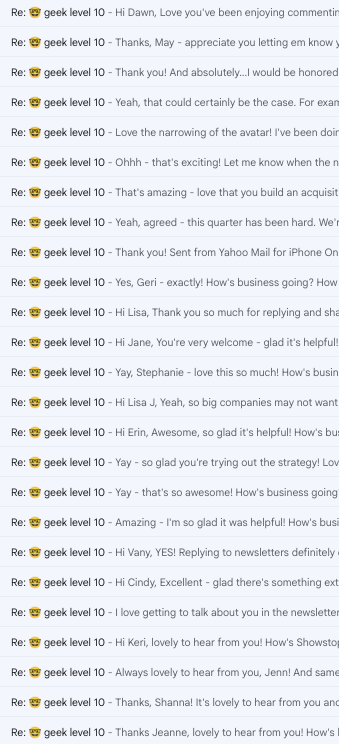
And when I asked my own newsletter readers to try it on me, nearly 30 of them hit reply. I wrote back to every single one, and spent a delightful week having actual conversations with actual humans.
Move 2: Send one specific, no-ask compliment
You don’t have to be ON podcasts for podcasts to grow your network (and your business).
I once listened to an episode with someone very senior on the Diary of a CEO team. Yes, that Diary of a CEO. She talked about an experimentation award they give out internally every week, and I thought it was brilliant. So I told her.
That’s it. That’s the whole move.
I didn’t pitch. I didn’t ask for anything. I just told her exactly what I’d taken from the episode.
She replied within a day. Warm. Personal. I now have a real connection with someone I had absolutely no business being connected to. Total cost: 90 seconds and one specific compliment.
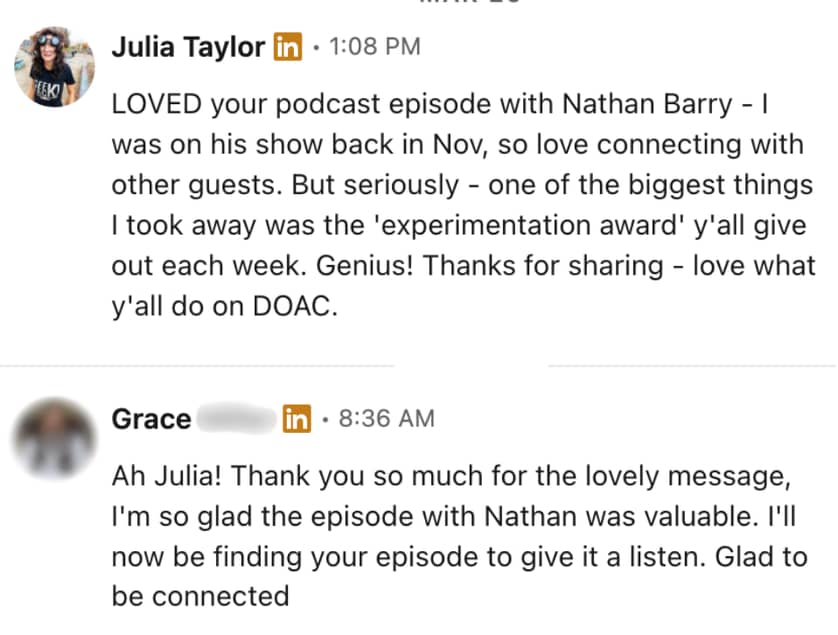
Notice what made it work. It wasn’t “love your podcast episode!”. It was the experimentation award, specifically.
Generic praise is noise. Specific praise is a conversation.
The no-ask part matters too. The second you attach a request, it becomes a transaction and they can feel it. With no ask, it’s just a person being generous, and those are rare enough to be memorable.
This works whether or not you’ve ever been a guest on the same podcast, and it works for anyone who publishes: a podcast host or guest, a newsletter writer, someone who made a free resource you actually used.
Move 3: Swap your typed follow-up for a 30-second voice note
Your typed follow-up isn’t getting ignored because people don’t care about you.
It’s getting ignored because typed messages carry zero tone. “Hey, just checking in!” reads exactly the same whether it came from you or a bot.
A 30-second voice note is different. They hear your actual voice. Your energy. The fact that you thought of them while you were doing something else. You can’t fake that with text… and you can’t ignore it the way you ignore text.
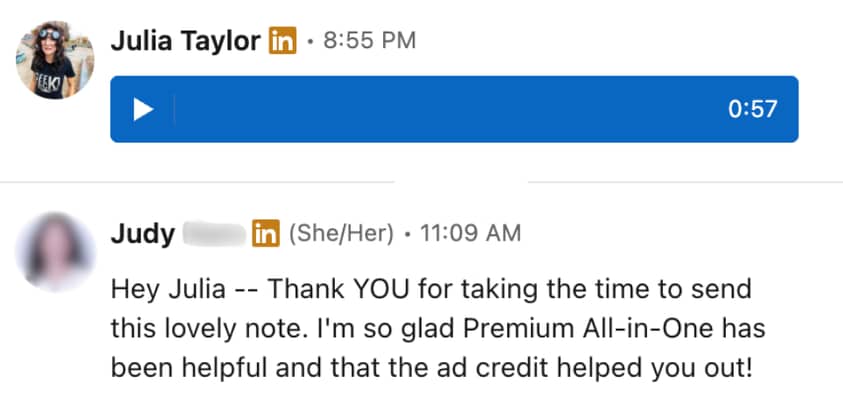
And this isn’t just for past clients. I once sent a voice note to the VP of Marketing for Small Business at LinkedIn. Not a mutual connection. Not a warm lead. A woman with a job title so far above my reach-out pay grade that I almost didn’t send it.
I wasn’t pitching anything. I just thanked her for something that had helped my business, in my own voice, in under a minute.
She listened to all 57 seconds. And she took the time to reply.
Because when someone talks to you instead of typing at you, you respond.
The structure is two parts:
- The reason you thought of them: “Hey, I just saw your post about the launch and thought of you.”
- A question about them… or better yet, no ask at all. A thank-you with zero ask might be the most disarming message a person can receive.
Where to send one: a LinkedIn message (you can record voice messages in the LinkedIn mobile app), Instagram DM, WhatsApp, or whatever app you already use with that person.
Now the embarrassing part. It worked. It cost me nothing. It took less than a minute. And I didn’t do it again for months. Not because it failed… because it never made it into my Revenue Rhythm (the small daily and weekly revenue actions I decide on in advance), so it disappeared under all the “productive” work. (It’s back in there now.) If that sounds familiar, Busy but Not Making Money? Revenue Work vs. Maintenance Work explains why.
Move 4: Put a P.S. in your email signature
Every introverted visibility move above requires you to actually do something. This one you set up once, in about ten minutes, and then it works on your behalf forever.
A few months ago I got an email from one of my RevenueOS clients. I don’t remember what the email was about. I do remember what was at the bottom of it. Right under her contact details, in italics, one line:
“P.S. Lexington Creative was recently featured as a Member Profile in the April 2026 issue of Avionics News (pg. 54) if you’d like more background.”
I clicked it. Obviously I clicked it.
Your email signature goes out on dozens of emails a week, hundreds a month, thousands a year, and mostly it just confirms you exist. That’s an enormous amount of real estate you’re already paying for and not using.
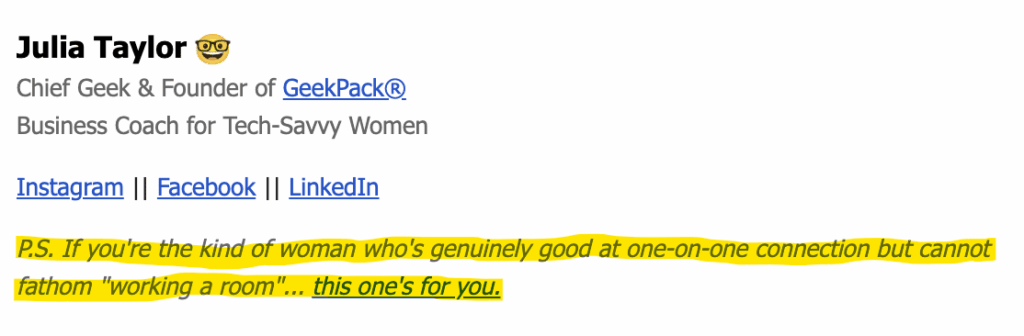
So I stole the idea (with her permission). Mine now says:
“P.S. If you’re the kind of woman who’s good at one-on-one connection but cannot fathom ‘working a room’… this one’s for you.”
That links to a six-second Instagram reel that does more to explain who I am and who I’m for than my entire homepage.
The rule most people get wrong: don’t link to your website or your LinkedIn profile. Your signature already has those. The P.S. should point to one specific thing someone can take in under a minute and immediately get you: a reel, a short article, a case study, a press feature, a podcast episode.
One thing that makes them go “oh… her.”
Not just an introverted visibility move… also the laziest possible visibility move. Which, for people like us, is the best kind.
Move 5: Ask for referrals on purpose (and write the blurb for them)
I once sat down and read back through a month of client calls (yes, this is what I enjoy doing in my spare time LOL). And there was one line I kept hearing over and over.
“Referrals have slowed down.”
“Referrals aren’t what they used to be.”
“My whole business started (and grew) from referrals… not anymore.”
On one call, before the client had even finished saying it, I said: “I literally hear that on every call that I do.”
And I wasn’t exaggerating.
- A brand strategist whose business was built almost entirely on referrals, and they’ve stalled.
- A web designer whose referrals still come in, but they’re all starter businesses with starter budgets.
- A PR consultant whose biggest contract just paused, leaving the pipeline suddenly empty.
- A marketing support business that lost two retainers when the clients brought the work in-house (hello, AI).
These are smart, experienced women with real track records. And almost all of them built their businesses the same way:
Someone told someone. The phone rang. Repeat.
And isn’t that the dream?! Clients just… showing up.
I hate to be the bearer of bad news, but… waiting for referrals isn’t a strategy. At best, it’s hope.
My husband has a saying I love (and equally hate): “Hope is a terrible planning strategy.”
Don’t get me wrong, I’m a hopeful person. But when I’ve got my business hat on and I’m planning revenue, “I hope someone sends me a client this month” isn’t a plan. It’s wishing.
The best place to start is still referrals. You just ask on purpose instead of hoping.
This is the one move on this list where you do ask for something. But it’s still about as introvert-friendly as it gets: one email, to someone who already likes your work, and once she passes it on, someone else does the talking for you.
Remove the friction: write it for them
People ask me for referrals and testimonials all the time. If I’ve worked with them (and was pleased with the result), I always say yes.
And then I say: “Can you write it for me?”
Not because I don’t want to help. Because I’m busy, and I don’t want to get it wrong. That’s friction. And your past clients feel exactly the same way.
So remove the friction. Write it for them.
The email (keep it short and personal):
Hi [Name],
[One personal line about them or something you worked on together.]
I’ve got a couple of spots opening up this quarter, and I’d love to fill them with people like you. Does anyone come to mind who might be a good fit?
To make it easy, I’ve written a short blurb below that you can copy and paste and pass along. No pressure at all.
The blurb (written about you, in the third person):
[Your name] helps [who] [get what result] without [the thing they dread]. [One line of proof: a result, a number, a client outcome.] If you know someone who [the specific situation they’re in], she’s worth a conversation: [link to book a call].
Yes, it’ll feel braggy and weird and uncomfortable. That’s the point. Your past client wants to get it right, so give her the words.
If you don’t want to write it yourself, drop a few client testimonials or a recent call transcript into your AI of choice and ask it to write a 3-sentence referral blurb about you in the third person. Then edit it until it sounds human.
Bonus geek move: look at who your past client is connected to on LinkedIn or Instagram. If you spot someone who’d be a great fit, name them: “Would you be open to introducing me to [Name], or anyone like her?” It’s much easier to say “oh, her!” than to think up someone from scratch.
That’s it. One email to one past client. About ten minutes.
Revenue on purpose. Not on hope.
Move 6: Show up on camera without talking to camera
Have you heard of “yapping”?
I once paid $1,000 to learn how to do it. Thirty days of every short-form video format you can think of… including the part where you just talk. Directly into the camera. About your thoughts. Unfiltered. For fun (apparently).
I tried it. I really did. And just thinking about doing it daily makes me want to burn the whole business to the ground and go walk my five miles in peace. A bit dramatic, I know.
So when a woman in my orbit got 400K followers in about five months doing exactly that, I watched it happen and felt… nothing. Zero FOMO. And it only took me 8 years to get there.
I’ve been doing short-form video since 2018, mostly kicking and screaming, and I’ve finally decided what I will and won’t do.
Yapping… hard pass.
Stories… nope.
So I figured out my version: I’m on camera, yes… but I’m not talking to camera (HUGE difference). Text overlays. Audio. Me doing something random: walking, drinking, trying to figure out the water tank issues in our basement.
That’s it. No yapping, no stories, no performing. Just showing up in a way I can actually sustain without wanting to throw my phone out the window and disappear into the woods.
And it’s working. More importantly, I’m not dreading it.
Stop chasing other people’s versions of visibility and get ruthlessly clear on your own.
How to choose which moves are yours
A client once told me on a coaching call, “You’re giving me comfortable ways to do this. Because some of it is so gross. I don’t want to be that.”
Same. Nobody wants to feel gross.
But business ownership is constantly pushing yourself a little further out of your comfort zone. Her answer to that was perfect: “Yes! So long as I don’t go outside of my values.”
Leave your comfort zone. Never leave your value zone.
Your comfort zone is what’s unfamiliar. Awkward. Slow to pay off. Sending the follow-up. Hitting publish. Saying your price out loud. That’s supposed to feel uncomfortable. Do it anyway.
Your value zone is what feels fake. The scripted DM. The “just checking in!” bump. Fake urgency. Performing extroversion on camera when you’re… not. That’s not discomfort. That’s not you. And no amount of pushing will make it you.
The tricky part is that in the moment they feel exactly the same. Both make you want to close the laptop. So ask yourself:
Is this uncomfortable… or is it not me?
If it’s uncomfortable, do it anyway. Small and messy is fine. If it’s not you, find another way to the same result. There’s almost always one.
Run the six moves above through that question. Replying to a stranger’s newsletter might feel awkward the first time. That’s your comfort zone, so send it anyway. Talking to camera every day might feel fake. That’s your value zone, so use Move 6’s version instead. Pick the two or three moves that pass, and make those your thing.
The catch: none of this is fast
Bad news: none of this is fast. It won’t get you rich quick.
Which is exactly why it works, and exactly why most people won’t do it.
Weeks of small, free, no-ask showing up. And then a conversation that would have been impossible to get any other way.
Try one today
Pick someone whose episode, newsletter or post actually helped you. Tell them what, specifically. Ask for nothing.
90 seconds. That’s the whole investment. The worst case is you made someone’s day and nothing else happened… which is still a better use of 90 seconds than most of what’s on your list right now.
P.S. Someone popped into your head while you were reading this. That wasn’t random. Start there.
Want to turn visibility into actual revenue? Showing up is half of it. The other half is knowing which conversations to have, and making them happen every week, even when the week gets busy. That’s what I teach in my free class, Busy Weeks, Broke Months.
Save your seat in the free class →
Or practice on me. Get my weekly newsletter, Entrepreneur Like a Girl, and hit reply to tell me the specific thing that landed. I read every reply, and I’ll remember your name.
Frequently asked questions
Can introverts be good at marketing?
Yes. Introverts are often good at exactly the kind of marketing that works best for service businesses: one-to-one connection, listening, and following up thoughtfully. Most marketing advice is written by extroverts who enjoy performing. You don’t need a different personality. You need moves that fit how you’re wired.
What is introverted visibility?
Introverted visibility is a way of marketing yourself without performing: showing up in a few chosen people’s worlds, over and over, being useful and asking for nothing. Replying to someone’s newsletter, sending a specific compliment, or adding a P.S. to your email signature are all examples.
How do introverts network online without feeling fake?
Start with people whose work you already value. Reply to their newsletters with something specific, comment on the posts nobody else engages with, and send a thank-you with no ask attached. If a tactic feels fake rather than just uncomfortable, it’s outside your value zone, so find another route to the same result.
What’s the easiest marketing move for an introvert to start with?
Adding a P.S. line to your email signature. You set it up once, in about ten minutes, and it works on every email you send from then on, without you having to post, call or pitch anyone.
Do I need to be on social media to market my business as an introvert?
Not in the way you’ve probably been told. Most of the moves in this post happen in inboxes and DMs, not in your feed. If you do use social media, pick a format you can sustain. For me, that’s being on camera without talking to camera.