


Here’s what it’s like on my end.
I write a newsletter every week. It goes out on a Tuesday, and then I go about my day, and mostly what I get back is data. Opens. Clicks. A dashboard that tells me a percentage of people were there.
What I almost never get is a person.
And when I do (when someone hits reply and says this specific bit, this is the thing that landed) I remember them. Not for a day. I remember their name. I go look them up. And if that person ever needs something from me, or I ever need something from them, they’re already in my head as a real human being rather than a row in a spreadsheet.
That’s not a nice sentiment.
That’s a strategy, and almost nobody uses it.
If you want to get noticed by dream clients without cold pitching, this is the move I’d start with. Below is the whole thing, step by step: who to pick, what to write, the two “geekier” levels most people never think of, and what to do when they write back.
The short answer
Subscribe to the newsletters of the people you’d love to work with, and reply to them. Not “great email!”, but the specific thing you took away and what you’re going to do with it. Do it consistently, ask for nothing, and over a few weeks you go from a stranger to a name they recognize.
Who this works for
This only works if your ideal client (or someone who’s well connected and could refer you to potential clients) is putting content out into the world. A newsletter especially, but social posts count too.
If the people you want to work with are completely invisible online, this isn’t your move. Try a no-ask compliment or a voice note instead.
But if they are putting content out consistently… then I guarantee you (based on personal experience), they’re also sitting there wondering if anyone’s actually finding it valuable.
Which is where you come in.
Step 1: Make a short list of dream clients
Make a list of people you’d LOVE to work with. Real people, real businesses… the ones who’d be a dream client.
Keep it short. I call it a “dream 10”: ten names you’d be thrilled to work with, or who are well connected to the people you’d be thrilled to work with. Ten is enough to keep up with every week without it turning into a second job.
Step 2: Check they’re the one actually writing
Before you invest weeks in someone’s inbox, check that your reply will reach the person who makes the decision. A newsletter written and signed by the founder is perfect. A company newsletter sent by a marketing team is less useful, because your reply may never cross the founder’s desk.
Same on social: a founder who personally posts on LinkedIn is a better bet than an Instagram account a team member runs.
Step 3: Subscribe (and make sure you’ll actually see them)
Go to their website. Sign up for their newsletter.
Then do the geeky bit: set up a label or folder in your inbox for your dream 10, with a filter that sends their emails straight there. Otherwise they get buried under everything else, and the habit dies in week two.
Step 4: Reply with the specific thing (Geek Level 1)
Every time their newsletter lands in your inbox, reply.
Not “great email!”… that’s noise. Reply with the specific thing you took away and what you’re going to do with it.
You can even prove your geekery and techy-ness: “Replying because I know it helps your deliverability… and because this bit about X actually changed something for me this week.”
Anyone who writes a newsletter knows exactly what a reply is worth. Saying it out loud doesn’t make it less generous. It makes you the person who understands their world (and their backend tech).
A reply you can adapt:
Hi [Name], replying because I know it helps your deliverability… and because your point about [specific thing] landed. I’m going to [what you’ll do with it] this week. Thanks for writing it.
Three sentences. No link to your website, no “let me know if you ever need help with…”. Just the reply.
Step 5: Click the sponsor, and say so (Geek Level 5)
If their newsletter has a sponsor in it… click the link and check it out.
Sponsors are how a lot of people with newsletters afford to keep making the free thing you’re enjoying. When a sponsor sees clicks, that creator gets renewed. When they don’t, the sponsor leaves and the whole thing gets harder.
So click the link. And then mention it in your reply:
“I also clicked your sponsor link. Super valuable stuff, thanks for making me aware of it.”
I promise you they will read that sentence twice. Almost nobody thinks about the business behind the newsletter they’re reading for free.
Step 6: Show up on their sponsored posts (Geek Level 10)
Same principle, different platform.
If someone’s doing sponsored content in their newsletter, there’s a decent chance they’re doing it on social too. And it’ll be labelled: #sponsored, #ad, #paidpartnership.
Here’s the thing about those posts… they almost always underperform. Everybody knows it. The creator knows it before they hit publish.
So show up there.
Not to game anything. Just because that’s the post they’re most nervous about, and it’s the one where a thoughtful comment is super rare… which means it’s the one where you’re most likely to be noticed.
Be the person who showed up on the post nobody else did.
Step 7: Keep going (for longer than feels reasonable)
Bad news: none of this is fast. It won’t get you rich quick.
Which is exactly why it works, and exactly why most people won’t do it.
Robin, GeekPack’s very own Revenue Coach, identified someone she wanted to work with who writes a LinkedIn newsletter. So she subscribed. And every single week, she read it and left a thoughtful comment. Not “great insights!”. Actual engagement, because she was actually learning something.
Weeks of this.
Then one week the woman replied to her comment and said, essentially, I have to meet you.
They got on a call. And the woman told Robin that she assumed people were reading… but nobody ever comments. That Robin taking the time meant more than she could explain.
As a rule of thumb, give it at least four weeks of showing up before you expect anything back. Some people will never reply, and that has nothing to do with you.
Step 8: When they reply, be a person
When someone writes back, reply like a human. Answer what they said, ask them something about their work, and let the conversation be a conversation.
Don’t use their reply as your opening to pitch. You’ve spent weeks proving you’re the person who gives without asking, so don’t undo that in one email. If there’s a fit, it tends to come up on its own (like Robin’s “I have to meet you”), or you’ll have a real reason to reach out later.
What it looks like when it works (and when it doesn’t)
I did this with Stu McLaren. I’d listened to two of his podcast episodes and changed things in my business because of them, so I replied to one of his emails and told him so. No ask. Nothing about me.
He didn’t reply.
His team did. They said they’d pass it on.
And honestly… that’s fine. That’s the realistic version of this. I’m not in Stu McLaren’s inner circle now. But I went from being nobody to being a name that crossed his team’s desk, for the cost of 90 seconds and zero dollars.
And when I asked my own newsletter readers to practice this on me? Nearly 30 of them hit reply. I wrote back to every single one, and spent a delightful week having actual conversations with actual humans.
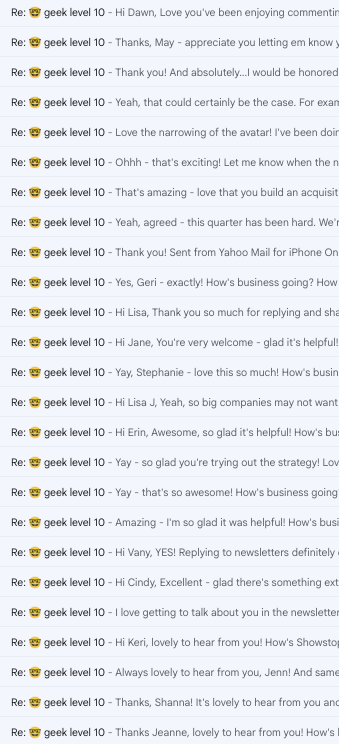
This is visibility for people who would rather do almost anything than “put themselves out there”.
You’re not performing.
You’re not posting.
You’re just showing up in someone’s world, repeatedly, being useful and asking for nothing.
This is Move 1 of six in Marketing for Introverts: 6 Visibility Moves That Don’t Require Performing.
Practice on me
Join my weekly newsletter, Entrepreneur Like a Girl, and hit reply to the first one with the specific thing that landed. I’ll read it, and I’ll remember your name. Consider it free practice with a friendly audience.
Want this reply as a fill-in-the-blank template, plus the other five moves? Grab my free Visibility Pack: six visibility moves you can do from your inbox, each with the exact words to send.
Get the free Visibility Pack →
Frequently asked questions
Does replying to a newsletter help the sender?
Yes. Replies are one of the clearest signals to email providers that a sender is a real person people want to hear from, which helps their emails keep landing in inboxes. Anyone who writes a newsletter knows that, which is why a reply is such a generous thing to send.
How often should I reply to someone’s newsletter?
Whenever an issue gives you something specific to say. If an issue doesn’t, skip it. A specific reply every few weeks is worth more than a generic one every week.
What if they never reply?
Some won’t, and that’s normal. You’ve still gone from a stranger to a name they’ve seen, often more than once. Keep going with the rest of your list, and don’t take the silence personally.
Is this the same as cold outreach?
No. Cold outreach asks for something from someone who doesn’t know you. This asks for nothing, and only starts once you’ve read their work. It’s how a cold contact becomes a warm one.