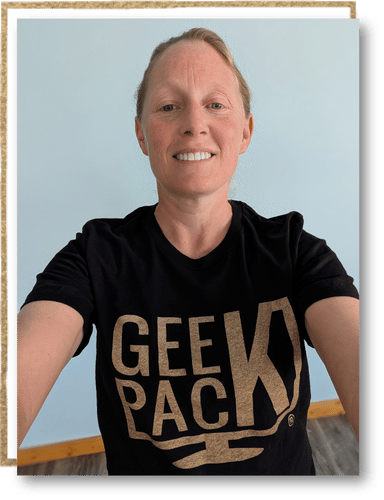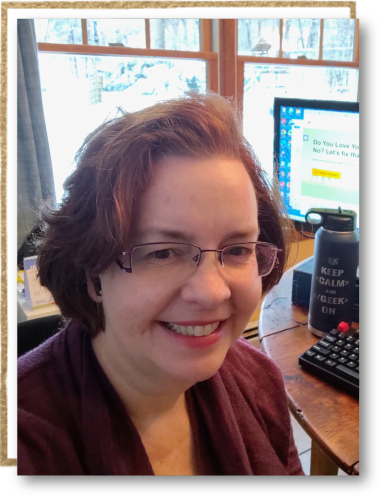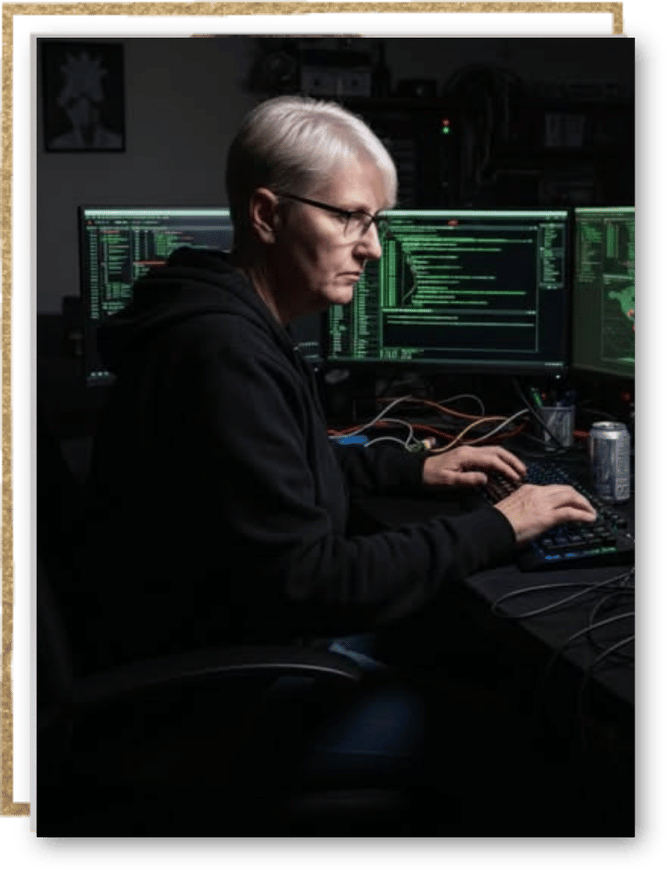
Kathryn Neel
https://mcgyverlabs.com/A former Google data scientist who had every technical skill in the book and needed a completely different framework to turn her expertise into consistent income.
"In some ways, I think trying to figure out how to make the money part of it work is harder than the technical part."
Kathryn Neel has had a career most people in tech could only dream of.
Systems engineer. Federal government contractor. Data scientist at Google.
And now, an independent founder building AI-driven privacy and security software for a joint venture that early investors are calling a potential multi-million-dollar opportunity.
On paper, she has it all figured out.
But ask her to write a contract, set a price, or build a consistent revenue pipeline - and a very different picture emerges.
"My problem is I'm really good at all the techy stuff," she says. "But I break out in hives if I have to do business stuff. It's a completely foreign language."
For most of her career, Kathryn didn't need to think about the business side.
She was the technical expert in the room, brought in to solve hard problems while someone else handled the selling, the negotiating, and the numbers.
Running her own company changed everything.
"One day everybody wants you and there's just not enough of you or your abilities to go around," she describes. "And then other days it's like, all you hear is the birds."
The feast-or-famine rhythm made planning nearly impossible and Kathryn is, by her own admission, a bit of a control freak.
She wanted stability. She wanted to be able to plan.
With a joint venture on the horizon that would require term sheets, NDAs, and contracts, the stakes were getting real.
"All of these make my teeth hurt," she admits. But she knew she couldn't keep avoiding it. "I have to at least be knowledgeable so I can know whether I should be spending money on an IP attorney or trying to hire another programmer part-time - or just sit there and go, forget it, I'll do it myself."
Kathryn first joined GeekPack during COVID, drawn in by the community at a time when she was feeling isolated and wanted to be around other women figuring out technology. This time, she came back for the cohort with a specific goal: figure out how to make revenue more consistent.
What she found was a framework that did something she hadn't expected. It gave her a way to apply the same analytical precision she'd spent decades bringing to technical problems - to her business instead.
"Keeping track of everything for the revenue part," she says, "because that's not really something I normally would do."
The exercise of reverse-engineering her financial goals from long-term target all the way down to the steps that had to happen first was, for her, the missing piece.
"I need to apply my detailed technical abilities to looking at financial spreadsheets and figuring out, what does this really mean for me long-term or short-term - and how do I keep the pipeline going at a fairly steady rate?"
For someone who jokes she used to take pay cuts for faster computers and expected pizza slid through the cubicle door as compensation enough, it was a genuine shift.
The cohort also pushed Kathryn to do the thing every introvert dreads: show up.
She describes herself as a severe introvert, but she also knew the uncomfortable truth: "If you're not seen, you're invisible - especially if you're a woman."
So she started making moves. During the cohort, she landed a paid website project for a local author - a friend-of-a-friend who paid the full amount upfront at their very first meeting.
She also started attending a weekly entrepreneur event called 1 Million Cups every Wednesday morning.
"Usually I wake up on Wednesday morning and I don't want to go," she admits. "But I make myself do it and I make myself talk to one person I don't know well."
It's working. "Now it's gotten to the point that people are coming to me for technical information or my opinion on something technical - and that puts me closer to selling my expertise."
She's taken her visibility further still, giving a presentation on alternative data center architectures to local government representatives. Unpaid - but strategic.
"I tend to run into this attitude that the only way you can be good at technology is if you're a 20-year-old guy wearing a hoodie," she says. "And that annoys me greatly."
The community is a big part of why Kathryn keeps coming back to GeekPack.
"That's actually why I originally joined," she explains.
What she found was something that kept pulling her back: people sharing the messy reality of building a business, out loud, without pretending to have all the answers.
"It's nice to hear other people talking about some of their struggles. It's like, oh, it's not just me."
She also noticed something that struck her as genuinely rare, especially compared to her experience in corporate tech.
"In technology, people tend to hoard knowledge and information. And having people who go, 'Yeah, I tried this, it didn't work' or 'Have you considered X, Y, or Z?' - I think that's incredibly important."
If Kathryn's joint venture takes off the way early conversations suggest, the work she did in the cohort on revenue tracking and pipeline management will matter more than ever.
She's not looking to slow down.
"If at some point I dropped dead with my boots on and my soldering iron in hand building my next computer," she laughs, "that's fine with me. I'm not ready to be granny and sit in a rocking chair."
Her message to anyone who has the technical skills but keeps putting off the business side?
"People learn these skills and get really excited about them. And then it doesn't really occur to them that not only is there going to be competition, but there's going to be a lot of indifference to what you're trying to do. You really have to make yourself visible. In a lot of different places."

Can you share a quick overview of your business?
I still build websites for friends and family and occasionally for people who don't understand websites at all. But my business has really grown more into things like — right now I'm in the process of trying to push forward on a joint venture with software that I built with a company, a security company in Northern Virginia. So I've sort of gone beyond websites into actually building customized AI-driven software.
How long have you been in business or working in this role?
I came into GeekPack during COVID. But my background is I was a systems engineer and I worked for the federal government, I worked for private companies. My last big corporate gig was I was a data scientist for Google. So I kind of come with a deeper background than most people.
Do you have anyone working with you?
I am sort of weirdly soloish on my joint venture project right now. I have someone I'm working with — he's not paid. He has a background in security contracting and he's the one that came to me. I had built a prototype of the software for a workshop, a very light version of it. And he came to me and said, "This would be great if you could modify it so it'll do these things for personal security companies." He has all the contacts — he's more the businessy guy than I am. He got me in touch with a friend of his who owns a high-end personal security company in Northern Virginia. I demonstrated the software and the guy got pretty excited.
What problems were you looking to solve by signing up for the cohort?
I just wanted to try to figure out a way to make revenue more consistent, because it seems to go in these waves. One day everybody wants you and there's just not enough of you or your abilities to go around, and then other days it's like, all you hear is the birds. I don't like that. I'm kind of a control freak. I want things to be pretty steady so I can plan for things. And now I'm getting to the point where with this project I'm working on, I have to do things like term sheets, contracts, NDAs — which all make my teeth hurt. I have to learn this stuff so I can actually protect myself and protect my product.
Have you seen any tangible returns from implementing what you learned?
Yes. I landed a paid website project during the cohort — a local author, a friend of a friend. He needed a new website desperately. I came up with three reasonable layouts for an author and let him pick from layouts I generated with AI for a look and feel. He chose the one he liked, which was also the one I thought was most appropriate. Then I built it in WordPress. It took about three weeks total — not because of the building, but mostly trying to extract information from him that I needed. Getting a single photograph from him took six days. But as of the end of the cohort, it's live and he's thrilled. And the nice thing was he just wrote the check — the whole check — right there at our first meeting, which rarely happens.
Do you feel more confident reaching out and selling than you did before?
Yeah, I am. I'm a severe introvert, so I've been making myself do things to put myself out there more. I'm giving a presentation on alternative architectures for data centers to a group of local government representatives. I'm not getting paid for it, but I'll definitely be seen. And every Wednesday I attend 1 Million Cups, which is a national entrepreneur event. Usually I wake up on Wednesday morning and I don't want to go. But I make myself do it and I make myself talk to one person I don't know well. Now it's gotten to the point that people are coming to me for technical information or my opinion on something technical, and that puts me closer to selling my expertise.
What were your biggest challenges during the cohort?
Putting myself out there more. I'm used to keeping to myself, going down my technological rabbit hole, and not dealing with people. I'm perfectly okay with that. And the truth is, if you're not seen, you're invisible — especially if you're a woman. So you kind of have to elbow your way into the crowd sometimes, no matter your age. If you're female, you really have to be loud and annoying, which isn't my natural state.
Did you feel supported going through the courses and being part of the community?
Yeah. That's actually why I originally joined GeekPack — I was feeling pretty isolated during COVID and I wanted to use my technical skills. And I'd had enough decades of working in a predominantly male environment — all the one-upmanship and jabs and comments. And I saw this community of women trying to learn technology, which I strongly support. I've worked with Girls Who Code, MakerFaire, I was a coach for First Robotics years ago. I always try to encourage women and girls to do this stuff because I'm convinced we can do a perfectly good job at it if we allow ourselves.
What was your most impactful takeaway from the cohort?
Keeping track of everything for the revenue part of it, because that's not really something I normally would do. Trying to figure out, okay, over the long term, this is my goal — how do I reverse engineer all the steps prior to that from a financial standpoint? Because I'm one of those people who basically collects all my paperwork and shoves it at my accountant. But I need to apply my detailed technical abilities to looking at financial spreadsheets and figuring out what it really means for me long-term or short-term, and how do I keep the pipeline going at a fairly steady rate.
What was the most valuable part of being in the program?
I really like the community. That's why I keep coming back. It's nice to hear other people talking about some of their struggles. It's like, oh, it's not just me. And also, using a system that somebody's already used and tested and then trying to replicate or adjust it so it works for me personally in my environment as it is now. And learning about how to keep a customer pipeline and money flowing through it was really pretty critically important to my involvement in this cohort.
What does the future look like for your business?
If this joint venture takes off, I may be sending Julia and the team a gift basket. When I joined GeekPack back during COVID, I've been involved with a lot of different stuff that I find supportive because it's not just me trying to figure all this out — it's a whole bunch of us from all over the world. So it's not like everybody else has the secret handshake and I'm the idiot. Being part of this community as well as learning new things and sharing them is incredibly important — especially because in technology, people tend to hoard knowledge and information. Having people who say, "Yeah, I tried this, it didn't work" or "Have you considered X, Y, or Z?" — I think that's incredibly important.
Any final thoughts you'd like to add?
I almost feel like this cohort should be a prequel to when people sign up for GeekPack to learn websites and skills. Because I think people learn these skills and get really excited about them, and then it doesn't really occur to them that not only is there going to be competition, but there's going to be a lot of indifference to what you're trying to do. So you really have to make yourself visible — in a lot of different places. And in some ways, I think trying to figure out how to make the money part of it work is harder than the technical part.




Copyright © 2021 - 2026 GeekPack, Inc| All Rights Reserved | Design by Soul Alchemy Branding | Built by GeekPack®
 Privacy Policy | Terms & Conditions | Refund Policy | Sitemap