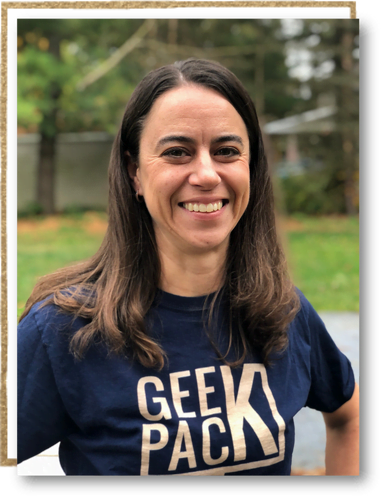
Sarah Noonan
https://sarndipitysolutions.com/After years of reshaping herself to fit other people's job descriptions, Sarah designed an offer she controls - the SarNDipity Blueprint - within the first couple of weeks of the cohort.
"It was a helpful framework to think about: what can I do this week to move the needle on a relationship or a potential project? That made it a lot less overwhelming than, 'Okay, how do I make money from nothing?'"
Sarah is an operations manager who works in a fractional capacity for another agency - and for a long time, that one client was her primary source of income. She'd been laid off before.
She knew what it felt like to need to replace an income quickly. And she knew she didn't want to be in that position again.
Sarah's problem wasn't a lack of skill. It was dependence.
"Being dependent on that company's profitability in order to support myself, I realized I needed to figure out something," she says. "I was looking for something - an offer I could bring to market that I could scale up or down depending on my volume of work from the agency at any given time.
She'd founded an LLC, SarNDipity Solutions, years earlier to support her fractional work. But she'd never really promoted an offer of her own.
"Part of me thought it'd just be easier to look for work. But I kept changing based on - all right, this is what the job wants, so I'm going to position myself like this. And then this is what this job wants, so I'm going to position myself in a different way."
The result:
"I didn't have a beta offer… I didn't really have anything to go pitch and go after sales for."
That realization was the turning point. "I realized I needed to create something of my own, even if it's very basic and fluid."
Sarah had worked with a career coach the year before, and that work shaped her thinking. But it wasn't until she started the Six Revenue Moves cohort - around the same time she began working with a personal coach - that she "really focused on launching something and measuring public response to it."
Inside the cohort, things moved fast. "Within the first couple of weeks of the Six Revenue Moves course, I designed a package," Sarah says.
She calls it the SarNDipity Blueprint: a complimentary discovery call, followed by an action report with her recommendations for how a solopreneur can get started - including a custom package for how they could keep working with her.
She built it out into a 5-hour and a 10-hour package.
"The GeekPack program really helped me think the whole thing through - my time, my expertise, and how to put a dollar value on that and sell it."
The offer connected straight into her Substack, where her series A Founder's Lens documents the exact process she used to launch it.
"I really had to go through my own process of creating an offer and putting it on the market. I needed to do that to be able to tell other people how to do that."
And her biggest takeaway from the program?
"Whatever you do, you need to be putting something out there continually - whether that's doing a blog post and promoting yourself, or following up with a client and saying, how is this proposal landing with you?"
Every class ended the same way: one outreach, right there in the session. For Sarah, that structure did the heavy lifting.
"That kind of forced me to reach out to a couple people that completed a market research survey I asked them to do - and then that facilitated some discovery calls and some opt-ins for the Substack."
The cohort itself became part of her network, too. When lesson three laid out the menu of revenue moves, Sarah offered a visibility opportunity to the group: she'd love to feature someone's story in her series. And a fellow participant said yes.
"I incorporated her story into my most recent article, and then she was able to share that post with her network. That gave me added credibility - because now it's not just me talking about my story."
Today, Sarah has an active proposal in the pipeline, to be revisited in the fall.
"Even though this particular project is on hold, I now have a working proposal to pitch using the strategies I learned in the Verizon cohort."
She's also turned on a paid subscription tier for her Substack - and that same client signed up for it.
"I'm starting to get subscribers that are in my target audience - founders, entrepreneur-curious individuals."
She's honest about the fact that the muscle is still building.
"It's still hard. Showing up for the calls and the training sessions - that was something I was good at. The outreach is harder."
But she's kept the notes document from class and keeps going back to it "to at least try to keep some of the conversations active."
She's even put AI to work on her biggest bottleneck: turning discovery-call notes into the action report, which used to take her hours. She now uses Claude to generate the first draft.
"There's a part of trial and error that AI can't really solve for you," she adds - the offer itself, she shaped by hand.
For Sarah, the support was a stark contrast to the rest of the industry.
"A lot of the people in the launch-your-own-business creator space come across as very intimidating," she says. "Julia was very accessible the whole time. It was great to see how many emails she answered directly - whether it was troubleshooting an issue I was having with the platform, or helping me through a specific stage of the program."
The community kept her on track between sessions - "just to be able to go back and say, all right, this is the lesson I have to do this week, and know where to find it and check it off."
And she didn't leave empty-handed on connections either: she went through everyone's bios, followed up with people in similar lines of work, and came away with new LinkedIn connections and Substack followers.
Sarah's number one tip for anyone chasing more consistent revenue comes straight from the cohort: plan your week.
"Set a benchmark of: this is how much I think I'm going to make this week. Then try to identify pockets of your schedule where you can take on more work."
She made a list of her personal expenses to work out exactly what her revenue target needed to be.
"I'm not there yet. I'm about halfway. So I'm just trying to find small wins: a subscription I can sell, or a project that can get me a little closer to my goals."
Sarah's eyes are firmly forward. More market testing of the SarNDipity Blueprint. Finishing A Founder's Lens and exploring ways to package it as a course or ebook.
And a bigger idea: "Building a resource hub for entrepreneurs - where we could showcase platforms like GeekPack and the Verizon grant, where people can come and get their questions answered and take steps forward, and have a community to support each other."
From nothing to pitch, to an offer with a name, a price, and a proposal on the table. That's what a few weeks of putting something out there continually looks like.

Can you start by sharing a quick overview of your business, your offer, and what that looks like for your clients?
Sure. I came to the Six Revenue Moves course working as an operations manager in a fractional capacity for another agency, and having that be my primary source of income. I was in a position where I was looking to not only augment that income, but have an offer to take to market that I controlled — pricing, packaging, sales, all of that.
Within the first couple of weeks of the Six Revenue Moves course, I designed a package that starts with a discovery call that's complimentary. It's designed primarily for solopreneurs, and could scale to additional businesses. I really built it from my own point of view of having been laid off from a job, needing to quickly replace that income, and trying to figure out how to turn my knowledge into a business.
That inspired my series called A Founder's Lens, which is a how-to about the process that I used to launch what I'm calling the SarNDipity Blueprint. The SarNDipity Blueprint is the follow-on to the Founder's Lens series, where readers who've read the articles about how to launch a business offer can come meet with me and discuss their ideas. They come away with an action report — my recommendations for how they get started — and included in that report is a custom package for them, of how they could work with me if they so chose.
It's something that's very much in beta right now. I have one proposal out, and I'm still doing a lot of discovery calls to shape the offer. But I came up with a 5-hour package and a 10-hour package. The GeekPack program really helped me think the whole thing through — my time, my expertise, and how to put a dollar value on that and sell it.
What was going on with revenue before the cohort? What problem were you hoping to solve when you joined?
I didn't really have a plan. Based on my own experience in the economy, and what I've seen echoed, I think a lot of people are starting to feel like gig workers. They're trying to make money and build a systemic approach around it, but they might have a full-time job that's not aligned with what they want, or a part-time job and a creator business. There are so many ways to both earn money and secure fulfilling work, and what I'm really focused on is trying to figure out how to do that systemically — so you can do more of what you want to do and make more revenue doing that.
Getting back to your question of what issues I was facing: I was working with one client, really, but I considered myself more of an in-house team member for that organization. Being dependent on that company's profitability in order to support myself, I realized I needed to figure out something. I was looking for an offer I could bring to market that I could scale up or down depending on how much the operations job was taking up of my time.
I didn't have a beta offer, so I didn't really have anything to go pitch and go after sales for. I addressed that by putting a preliminary package together for a woman I'd met through volunteer advising, and saying: combining that with the work I'm doing in the operations role, this is what I can do. Let's see what people want, what they need, what they have the budget to pay for, and what they're willing to pay for. So the offer is very much still in entry stage.
The big takeaway from the GeekPack program was: whatever you do, you need to be putting something out there continually — whether that's doing a blog post and promoting yourself, or following up with a client and saying, how is this proposal landing with you? Doing what you can to find someone who's willing to pay for your time and expertise.
Had you tried a structured approach like this to generate revenue before? If so, what was different this time?
I'd been in this position for several years and had founded an LLC to support the fractional work I was doing. I hadn't really done a lot to promote the offer — part of me thought it'd just be easier to look for work.
The same struggles I've had in bringing this offer to light were ones I faced in the job market, where I kept changing based on: all right, this is what the job wants, so I'm going to position myself like this. And then this is what this job wants, so I'm going to position myself in a different way. I realized: let me create something of my own, even if it's very basic and fluid. That can help me shape what kind of work I want to do — and if I do want to pursue outside employment, I can look at how it aligns with the basic offer I built.
I had worked with a career coach a year previously, and the work we did ultimately shaped what I put together. But it really wasn't until I started working with a personal coach — around the same time that I started the GeekPack program — that I really focused on launching something and measuring public response to it.
You mentioned tying your offer into your Substack writing. Can you share how that looks, and how the cohort helped you connect your content and revenue in a way you hadn't done before?
Sure. I had started a series called A Founder's Lens within my Substack, with the vision of potentially packaging it into a course or ebook. My first goal was just to have some content out there that I could point people towards — these are problems I've worked through and how I've solved them.
I've written four installments. It started out more theoretical, about trends in the market and people going solopreneurial. Then as I launched the SarNDipity Blueprint, I really had to go through my own process of creating an offer and putting it on the market. I needed to do that to be able to tell other people how to do that. The experience of launching the offer helped me write two of my articles, and I'm looking now to conclude the series within the next couple of installments. I have enough material now that I can develop an outline for the rest of the posts.
The other thing that came out of it: in the lesson that had all the different revenue moves you could choose from, one of the things I said was, if anyone is looking for a visibility opportunity, I have a series — I'd love to feature your story. Keri Darling, one of the other participants in the program, was interested. I incorporated her story into my most recent article, and then she was able to share that post with her network. That gave me added credibility, because now it's not just me talking about my story — I've talked to other entrepreneurs who've gone through similar things.
Have you seen any tangible returns — more revenue, new clients, proposals, deals that closed — in this period?
Yes. I have an active proposal out there. The person is applying for grant funding, and she's included my proposal in her grant application. I'm hopeful that she gets the grant and is able to hire me — that would be my first sale outside of the fractional role.
I do have a paid subscription tier for my Substack. It's a lot of friends and family support right now, but this woman also signed up for the paid tier. So I'm starting to get subscribers that are in my target audience — founders, entrepreneur-curious individuals.
The other thing that was helpful was the one outreach we had at the end of every class. That kind of forced me to reach out to a couple of people that completed a market research survey I asked them to do, and that facilitated some discovery calls and some opt-ins for the Substack. It's been lots of moving parts, but it's starting to align.
Are there any specific tools or AI that you've started using to support your revenue work?
For outreach, I tend to still use my own instinct rather than "tell me what to say to this person" — unless I'm really stuck. I recently upgraded to Claude Pro and have been playing with some of its recommendations. It came up with an idea for helping me after a discovery call: putting the notes into Claude and having it generate a first draft of the report. That had been a hangup, because it would take me a few hours — especially with my other job, not always being able to get to it right away. So I'm going to try that on my next discovery call.
I think there's a part of trial and error that AI can't really solve for you.
Do you feel more confident going after revenue — reaching out, following up, making the ask — than you did before the cohort?
Yes. I mean, it's still hard. It's funny — I went on vacation right after this, and coming back I realized that showing up for the calls and the training sessions was something I was good at, but the outreach is harder. I still have the notes document I used in the class, so I'm continuing to go back to that, along with my own systems, to at least try to keep some of the conversations I've had active.
Did you feel supported by the coaching and the cohort community, and did that help you follow through with your revenue moves?
Yes. A lot of the people in the launch-your-own-business creator space come across as very intimidating, and Julia was very accessible the whole time. It was great to see how many emails she answered directly — whether it was troubleshooting an issue I was having with the platform, or helping me through a specific stage of the program. That was really great.
The Circle platform was really helpful too — just to be able to go back and say, all right, this is the lesson I have to do this week, and know where to find it and check it off. And also just to stay in touch with the people in the cohort.
Did you make some good connections in this cohort?
Yes. I went through everyone's bios and followed up with a couple of people who were in similar lines of work to me — made a couple of LinkedIn connections and Substack followers.
One thing that would be interesting — I noticed the Verizon cohort space has since been removed — is maybe having a Google Sheet where everyone can have their information and stay in touch with each other.
What was your most impactful takeaway, or the most valuable part of being in this cohort?
This has been a big adjustment for me, going from full-time work to solopreneurship. It's really hard — you feel unproductive all the time, because you're thinking, I'm not making money right now. It was a helpful framework to think about: what can I do this week to move the needle on a relationship or a potential project? That made it a lot less overwhelming than, okay, how do I make money from nothing?
Even having the notes of people I reached out to, and being able to go back and say: okay, is there anything I can do to move this conversation forward, or would I rather start fresh and go to a new person?
What's your number one tip for someone who wants to get more consistent with revenue in their business?
I'm a big fan of the exercise of planning your week — that was really helpful. If they have a client they bill by the hour, or a project they're working on, they can block that off and set a benchmark: this is how much I think I'm going to make this week. Then try to identify pockets of their schedule where they can take on more work.
And realize that capacity might change over time. They might have a time where they have a heavy client load and don't have the capacity to go after additional projects — but they don't necessarily need to, because they've got a full revenue load.
I made a list of my personal expenses to see what my revenue target needed to be. And I'm not there yet — I'm about halfway. So I'm just trying to find small wins: a subscription I can sell, or a project that can get me a little closer to my goals.
Did the cohort help you with going through the courses on the Verizon platform?
Yes — those were pretty straightforward, and I liked how Julia would put her own spin on them each week. It was more of a jumping-off point than a review of the material.
Right now, I did the workshop on applying for the grants, and I'm thinking about what kind of project I would want to do for them. I'm thinking of building some sort of website hub that would connect the advising work, the content, and the network of entrepreneurs that I've built.
What does the future look like for your business now, and any revenue goals you're chasing next?
Doing some more market testing of the SarNDipity Blueprint. I want to finish up the Founder's Lens series and explore ways to package that as a course or ebook.
And then this idea of building a resource hub for entrepreneurs — where we could showcase platforms like GeekPack and the Verizon grant, where people can come and get their questions answered and take steps forward, and have a community to support each other.



Copyright © 2021 - 2026 GeekPack, Inc| All Rights Reserved | Design by Soul Alchemy Branding | Built by GeekPack®
 Privacy Policy | Terms & Conditions | Refund Policy | Sitemap